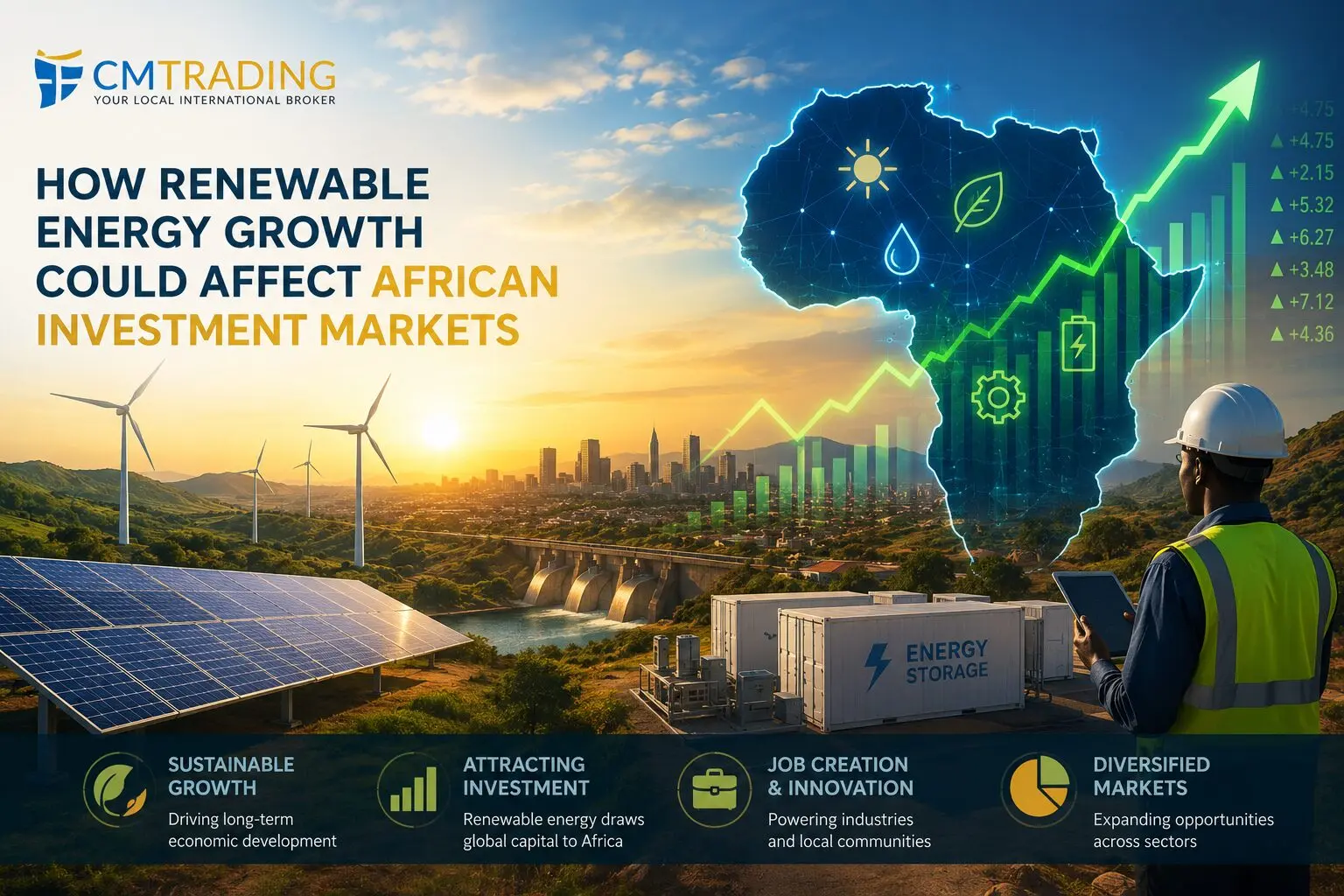
Africa stands at a remarkable crossroads. The continent holds 60% of the world’s best solar resources and commands wind potential that could theoretically power it 250 times over. It also sits atop vast reserves of the critical minerals that the global energy transition depends on: cobalt, copper, nickel, lithium, and manganese. Yet it accounts for only 1% of the total global installed solar capacity, and around 600 million people on the continent lack access to consistent electricity. It is the gap between these two aspects that is attracting huge investments in the continent today, and the resulting impact on African investment markets.
As project economics continue to improve, Africa’s renewable energy sector has become one of the most attractive investment opportunities across emerging markets. Investors seeking broader exposure to global financial markets often use platforms that support online trading like CMTrading across multiple asset classes, allowing them to track trends connected to energy, infrastructure, and economic growth.
The Investment Surge Is Already Underway
Clean energy investment by the private sector in Africa has more than doubled from 2019 to 2024. Investment worth close to $17 billion in 2019 rose to $40 billion in 2024. Foreign Direct Investment into the continent also surged to $97 billion in 2024 from $55 billion in 2023. This is no small increase.
Most of the above-stated growth momentum can be attributed to declining technology prices. For example, the cost of solar photovoltaic panels has been reduced by half during the last decade; consequently, solar energy has become one of the cheapest energy sources on earth. Solar power stations in Kenya generate 60% higher energy levels than those in Europe. Institutional investors have taken notice of this trend as project economics continue to improve. As a result, Africa’s renewable energy sector has become one of the most attractive investment opportunities across emerging markets.
There has also been additional momentum coming from policy reform initiatives. South Africa, Egypt, and Morocco have developed clearer regulatory frameworks, procurement processes, etc. The REIPPPP program implemented in South Africa has become a successful example of the country’s energy policy for the entire continent.
New Players, New Capital Structures
What makes this investment cycle unique is the diversity of capital sources involved. The GCC nations, especially the UAE, Saudi Arabia, and Qatar, have become new significant supporters of African energy and infrastructure. In 2019-2023, the UAE alone pledged approximately $110 billion in investments to Africa, with $72 billion directed at renewable energy projects. During COP28, the UAE promised $4.5 billion to speed up clean energy projects in Africa.
This kind of money does not simply remain at a financial level; rather, it is being invested by Gulf companies, such as Masdar (Abu Dhabi Future Energy Company) and AMEA Power, to develop and own renewable facilities. Infinity Power, a Masdar company, has become the largest renewable energy company in Africa following the acquisition of Lekela Power’s wind facilities in Senegal, Egypt, and South Africa. Another Gulf player, Saudi Arabia’s ACWA Power, is developing one of the largest hybrid renewable power projects in South Africa called Project DAO, worth $800 million.
In many instances, projects rely on blended finance, which blends public development finance with private funds to equally distribute risks. It has been found that this approach is particularly essential for ensuring projects’ bankability in markets that are normally too risky for commercial financing without involving other financing instruments. Blended finance performs well, according to experts, if there is risk sharing, proper alignment of interests, and good governance in the arrangement, especially if international financiers are involved.
As renewable-energy investment scales across the continent, investors are increasingly assessing its impact on commodity markets, currencies, and broader economic growth.
Renewable-energy expansion can also influence commodity demand, particularly for metals and minerals used in solar panels, batteries, and grid infrastructure. As a result, many investors closely monitor Commodity Markets to better understand how the energy transition may affect resource prices and investment opportunities.
Which Markets Are Moving Fastest?
South Africa, Egypt, Morocco, and Kenya continue to attract the majority of renewable-energy investment due to their natural resources, policy frameworks, and market maturity. The Noor Ouarzazate Solar Complex, the largest concentrated solar power plant on the planet, is located in Morocco. Kenya has achieved dominance in geothermal energy production; it is one of the leaders in installed capacities of geothermal energy, producing almost one gigawatt and being the seventh in the world in geothermal energy production.
Beyond these leading markets, a second wave of countries is beginning to attract investor attention. Rwanda is developing its decentralized solar mini-grid to supply rural areas with electricity. Tunisia set a goal to produce 30 percent of its energy using renewable energy by 2030. Algeria is developing the Tafouk 1 Mega Solar Project, a large-scale solar initiative designed to significantly expand the country’s renewable-energy capacity. Namibia is considered to be the hub of green hydrogen; it set a goal to reach zero emissions by 2050 and is a member of APRA, which aims to invest $100 billion in green energy in Africa.
These developing markets not only present more risks but also more potential rewards. Predictable regulation, stable currency exchange rates, and strength of the off-take agreements become important variables to be considered by investors before any investment.
What Investors Need to Understand
Developing renewable energy projects in Africa is a real challenge. Developers together with their investors should take into account a highly variable socio-political situation, an unpredictable regulatory framework, and competition on the market, which requires careful preparation. On average, interest rates for renewable projects in Africa stand at 8.2% against 4.4% in Europe.
Several points become especially important for investors’ attention: the regulatory stability of the host country, bankability of Power Purchase Agreements (PPA) secured with creditworthy off-takers, thorough assessment and evaluation of the resources and financial model, and availability of risk management tools like guarantees and insurance products.
Community involvement has become one of the most important, yet often overlooked, risks. Investments whose community backing is lacking are doomed to delays, resistance, and reputation problems, which would jeopardize their financial implementation process. The best developers consider engagement with stakeholders as an essential element of safeguarding investments, rather than a bureaucratic formality.
The Broader Economic Implications
Investments into renewable energy projects in Africa have far-reaching consequences for the continent, going way beyond the sphere of energy production alone. With its infrastructure deficit, Africa needs $130–170 billion worth of investments per year, whereas only $80 billion is raised at the moment. In this way, investment in clean energy closes the gap and enhances the enabling environment for other economic activities, as access to stable energy sources becomes fundamental for industrialization, digital connections, and agricultural efficiency.
This brings us to the minerals aspect. The continent possesses ample quantities of the minerals that are necessary for building solar panels, wind generators, and batteries for storing the energy. With the increase in demand for such resources projected in the next decades, the countries capable of harnessing their energy production potential as well as mineral processing capacity will enjoy a tremendous multiplier effect.
The concept of a just transition, which entails that the move away from fossil fuels should not unduly affect workers or communities, is increasingly becoming a factor in the way investors look at projects. The Just Energy Transition Partnership for South Africa, which received $8.5 billion from developed countries, is an example, though other just transition models are also appearing on the continent. The Nigerian energy transition model requires $410 billion in funding until 2060, but has the potential of creating 840,000 jobs.
Looking Ahead
While renewable energy investment in Africa is expected to continue growing, questions remain about how evenly the benefits will be distributed across countries, industries, and local communities. The capital being invested heavily favors large export-oriented projects in renewable energy and mining at the expense of small community projects. Sectors vital for climate adaptation, such as water and sanitation services and local grid infrastructure, are underfunded.
The single most important message for the investment community is structural: Africa is no longer a frontier market in need of an extra risk premium to attract investments. For those investors willing to accept the challenge and invest time into understanding the continent and establishing genuine stakeholder relationships, the renewable energy industry provides an unbeatable mix of high return on investment, development impact, and strategic position.
For investors, renewable energy is no longer simply an infrastructure story. It is becoming a key driver of economic transformation across Africa. As capital flows accelerate and energy systems modernize, the continent’s investment markets are likely to offer some of the most compelling growth opportunities of the global energy transition.
Investors looking to follow long-term renewable-energy developments can also monitor research and investment trends published by the International Renewable Energy Agency (IRENA), which regularly tracks renewable-energy deployment, investment flows, and policy developments worldwide.